Do window AC units pull air from outside? In Arden-Arcade, CA, the honest answer is almost never, unless a manual vent lever is switched on or the cabinet seal has failed. Here's exactly how the airflow works, when outside air really gets in, and what that means once wildfire-smoke season rolls around.
Do Window AC Units Pull Air From Outside? The Short Answer
Under normal operation, window air conditioners do not pull outside air into your room. They recirculate indoor air across a cold coil and blow it back out. The one common exception is a manual vent lever found on some models, which opens a small damper to let in a limited amount of outside air.
So if you're asking whether this is a daily concern for your Arden-Arcade home, the short answer is no, not unless that lever is switched on. That distinction carries more weight here than in milder climates. Dry summer heat means opening that vent rarely helps your comfort, and during wildfire-smoke season, it can actively work against you.
We'll cover that exception, along with leak signs and smoke-season precautions, below. If you want a professional look at how your unit is sealed and running, our air conditioning repair team serves homes throughout Arden-Arcade.
How a Window AC Actually Moves Air
A window unit is really two separate machines sharing one cabinet. A metal partition inside splits the box into an indoor side and an outdoor side, and air from each side never physically mixes under normal operation.
On the indoor side, room air gets pulled across the evaporator coil, where it loses heat and moisture before blowing back into the room as cooled air. On the outdoor side, air from outside passes over the condenser coil, absorbing the heat pulled from your room, and that warmed air exhausts back outdoors through the rear grille. These are two separate air paths operating as a closed-loop system on the indoor side. The unit is built to recirculate conditioned air, not exchange it with the outside.
Here's a side-by-side breakdown of what's happening on each side of that partition:
| Indoor Air Path | Outdoor Air Path | |
|---|---|---|
| What enters | Room air pulled through the front grille | Outside air pulled through the rear/side vents |
| What happens | Passes over the cold evaporator coil, loses heat and humidity | Passes over the hot condenser coil, absorbs rejected heat |
| Where it exits | Blown back into the room as cooled, filtered air | Exhausted outside through the back of the unit |
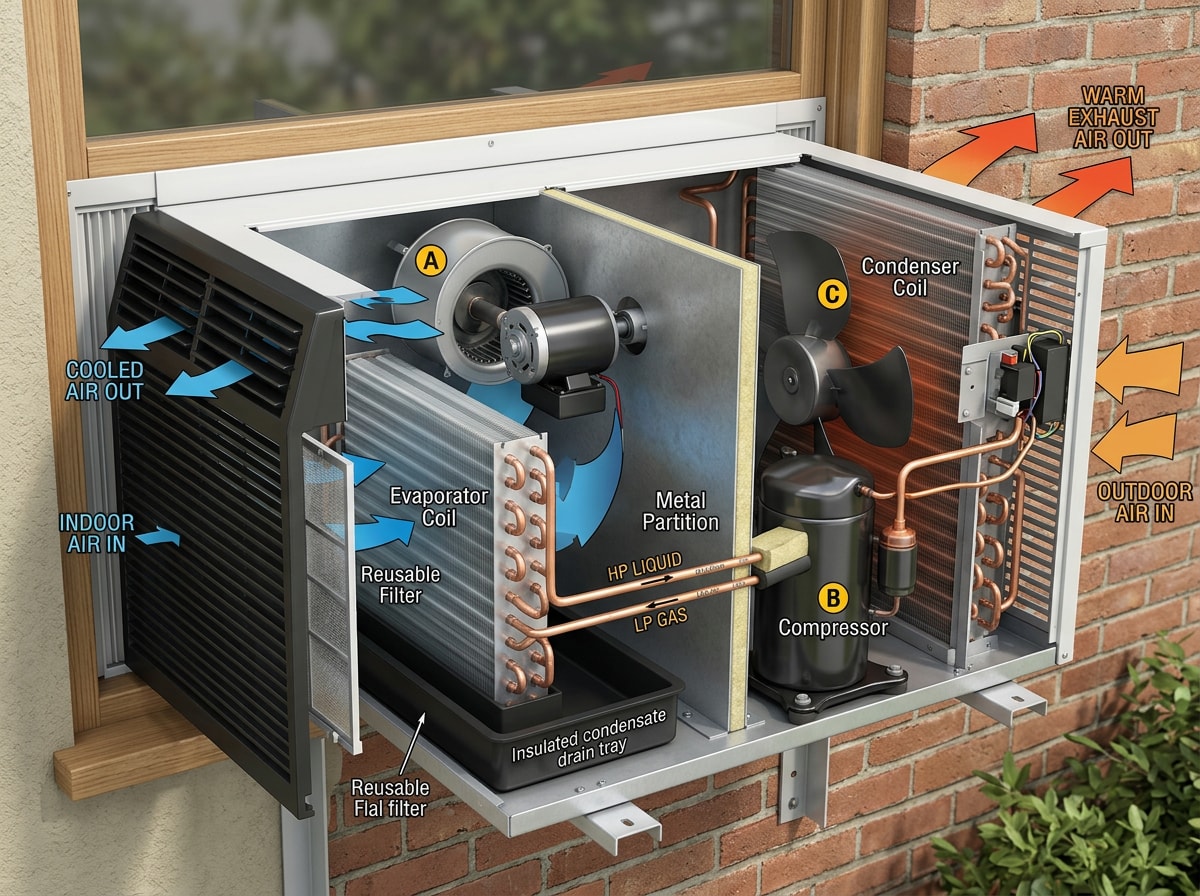
Because these two loops stay isolated, the air you breathe indoors is the same air being cooled and recirculated, not fresh air pulled in from your yard or street.
The Manual Vent Lever: The One Real Exception
Some window units include a small vent lever or slider on the front panel, usually labeled "vent" or "fresh air." Flipping it opens a damper that lets a thin stream of outside air mix into the indoor airflow, a limited version of fresh-air mode, not true ventilation like a whole-home fresh-air intake system.
Most newer units ship with this damper closed by default, and plenty of budget or compact models don't include the feature at all. It's an optional extra, not a standard part.
There's a real trade-off to using it here. Pulling in hot, dry Arden-Arcade summer air makes the compressor work harder to maintain your set temperature, which drags down cooling efficiency and can raise your energy bill. An oversized air conditioner costs more to purchase, wastes energy and does not provide better cooling , and the same logic applies to any added heat load from an open vent damper, according to ENERGY STAR's room air conditioner buying guidance.
Signs Outside Air Is Getting Into Your Window Unit
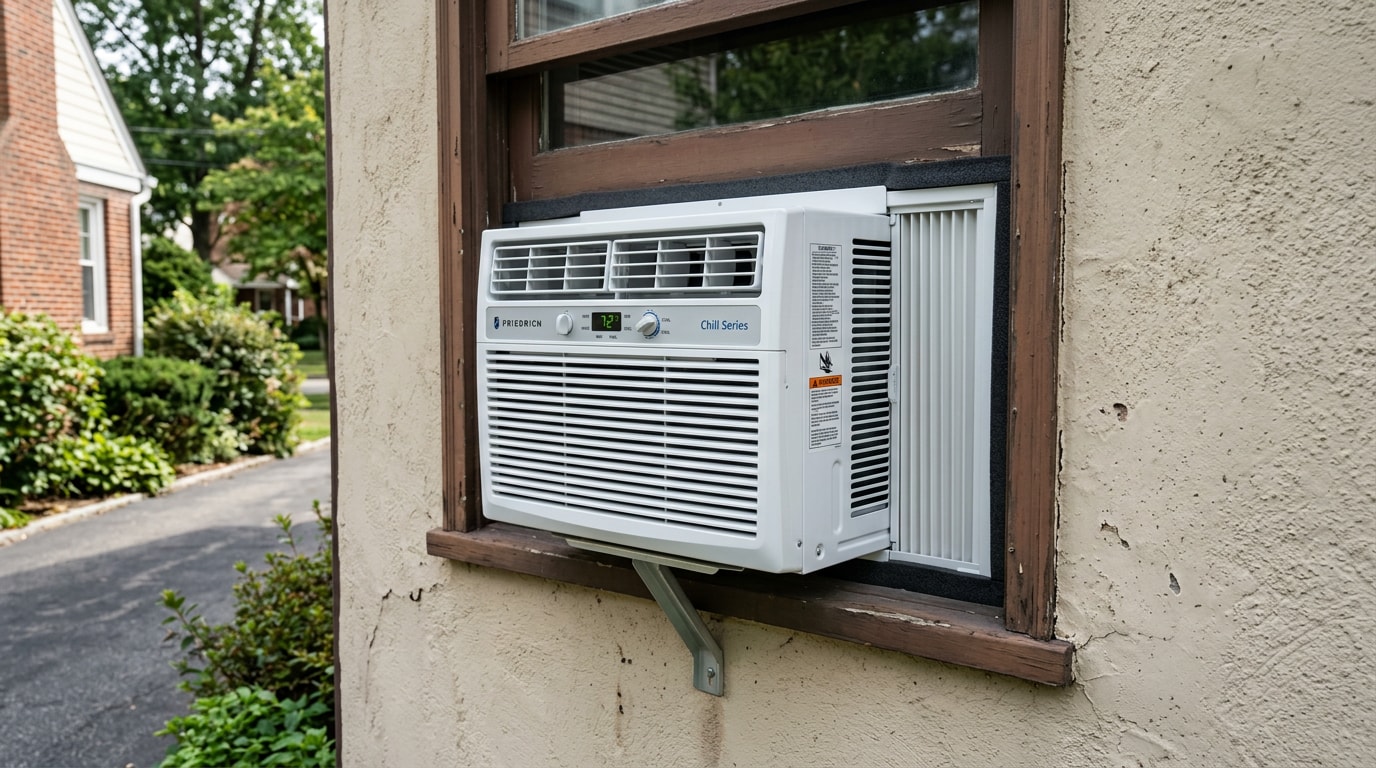
If you smell outside air or feel a draft near your unit even with the vent lever closed, that's almost always an air leak, not a design feature. Common culprits include gaps around the cabinet frame, a bent or warped housing, and deteriorated foam seals.
In our service calls across Arden-Arcade and the broader Sacramento Valley, cabinet-seal leaks show up far more often than an intentionally open vent lever. It's usually foam gaskets that have compressed or cracked after a few summers of heat cycling.
Walk around your unit and check for these:
- Visible gaps where the cabinet meets the window frame or sash
- A worn or missing gasket along the top, sides, or bottom
- A noticeably drafty feel near the seams, even with the vent closed
- Foam seal strips that have compressed, cracked, or fallen out over time
A properly sealed unit keeps indoor and outdoor air separate the way it was designed to. When a homeowner tells us their room smells like outside when the AC is on, it's rarely the vent lever doing that. It's usually a sealing problem that a quick AC repair service visit can catch before it turns into a bigger comfort or efficiency issue.
What a Window AC Can (and Can't) Do for Indoor Air Quality
A window unit filters the indoor air it recirculates, but it does not purify that air or exchange it with fresh outside air. Its mesh filter catches larger particles like dust and pollen as room air passes through, which genuinely helps with everyday indoor air quality, but it's not the same as true air purification.
That distinction matters for allergy- or asthma-sensitive households. The standard filter in most window units is a basic mesh, not a HEPA-level filter, so it won't capture fine particulates or smoke-sized particles. Flat or panel air filters with a MERV of 1 to 4 are commonly used in residential furnaces and air conditioners , per the EPA's Guide to Air Cleaners in the Home. That low rating traps dust and pollen reasonably well while leaving smaller allergens largely untouched.
If you want filtered air that goes further than a stock window-unit filter, an upgraded air filtration system or an indoor air quality consultation can help you figure out what's actually practical for your home.
Vent Mode or Standard Cooling: Which Fits Your Room?
For nearly all everyday cooling, standard recirculating mode is the better choice. It keeps the vent lever closed and runs more efficiently than fan-only or vent-assisted settings. Vent mode only makes sense in narrow situations, like a cool Arden-Arcade morning or evening when outdoor air is actually cooler than your room.
In that case, briefly using vent mode or switching to fan-only mode can offer a bit of free cooling without running the compressor at all. It's also sometimes used to clear a stale odor from a room quickly.
Knowing when to open the vent also means knowing when not to. Skip it entirely on days with wildfire smoke, heavy pollen, or any outdoor air quality advisory. That's exactly the air you don't want mixing into your home.
Wildfire Smoke and Window ACs
A sealed, well-maintained window AC running in standard mode doesn't normally pull wildfire smoke indoors, since it's recirculating room air rather than drawing from outside. The risk comes from a leaky cabinet or an open vent lever, either of which can let smoke particles slip in during a bad air day.
The EPA's guidance on this is direct: if your HVAC system or window air conditioner has a fresh air option, meaning it pulls in air from the outside, turn it off, close the intake, or set the system to recirculate mode during a smoke event. A few practical steps make that easier to follow:
- Keep the window AC vent closed during any smoke event, even if you normally use it for mild-weather cooling.
- Check the cabinet seal and gaskets before smoke season hits, since gaps are the main way smoke sneaks in.
- Pair the AC with a portable air cleaner for fine particles, since stock mesh filters sit around a MERV rating of 1 to 4 and won't stop smoke-sized particulates.
See the EPA's guide to creating a clean room during wildfire smoke for more detail on protecting indoor air during active smoke events. Our emergency air conditioning repair guide for Arden-Arcade covers what to do if your unit struggles right as smoke or heat hits at the same time.
A 3-Step Plan for Fresh Air Without Losing Efficiency
You can get some outside air exchange without tanking your cooling bill. It just takes a slightly different approach than flipping the vent lever.
- Ventilate safely at the right time. Open windows and run a fan during cooler morning or evening hours instead of relying on the AC's vent setting.
- Seal the unit properly. Replace worn gaskets and close gaps around the cabinet so the system runs as the closed loop it was built to be.
- Add a dedicated air purifier. For continuous fresh air without losing efficiency, a standalone purifier handles filtration while your AC focuses purely on cooling.
Not sure which of these three steps fits your situation? Get a free estimate and we'll take a quick look at your unit's seal, filter, and overall condition. Hot Cold HVAC technicians check window and split-system seals as a standard part of every AC maintenance visit in Arden-Arcade, and that inspection is often what catches a leak before smoke season makes it a real problem. You can see more of that work on our projects page or learn more about the company on the homepage.
FAQ
Do window AC units pull air from outside?
No, not under normal operation. Window AC units recirculate and cool indoor air in a closed loop. Only a manual vent lever, if the model has one, lets in a small amount of outside air.
Do all window air conditioners have a fresh air vent?
No. A fresh air vent lever is an optional feature found on some models, not a standard part of every window AC. Many budget and older units don't include one at all.
Which is better, vent open or closed?
Closed is better for nearly all everyday use, since it keeps cooling efficiency high and avoids pulling in unwanted outside air. Only open it briefly when outdoor air is cooler than indoor air, and never during smoke or poor air quality days.
Is it safe to run a window AC during wildfire smoke?
Yes, as long as the vent lever is closed and the cabinet is well sealed. Pairing it with a portable air purifier adds extra protection, since the stock filter won't stop fine smoke particles.
Why doesn't my window AC cool as well when the vent is open?
Opening the vent pulls in hot outside air that mixes with the air your unit is trying to cool. That added heat load makes the compressor work harder, which lowers efficiency and slows recovery to your set temperature.
Can wildfire smoke get into a window AC even with the vent closed?
Yes, if the cabinet seal is leaking. A closed vent lever only stops the intentional air path. Gaps around a worn gasket or an ill-fitting cabinet can still let smoke in around the unit.
What's the difference between fresh air and filtered air?
Fresh air comes from outside through an open vent damper, while filtered air is indoor air that's been recirculated through the unit's mesh filter. Filtered air removes some dust and pollen but doesn't add new outside air.