Sacramento's record-breaking heat demands smart decisions. Repair that aging AC or replace it? We break down real 2026 costs, the 50% rule, and what makes financial sense.
Share:

Summary:
AC repair costs in Sacramento, CA range from $300 for straightforward fixes to $3,500+ when major components fail. Where you land in that range depends entirely on what’s broken and when you’re calling for service.
Minor repairs like clogged filters, thermostat replacements, or capacitor swaps typically run $100-$300. These are the wins—quick fixes that restore function without draining your account. Moderate issues like refrigerant recharges, ductwork repairs, or fan motor replacements cost $300-$600. Then there’s the expensive territory where compressor replacements hit $1,800-$2,800 and complex refrigerant leaks requiring extensive work reach $600-$1,500.
Labor rates in Sacramento, CA average $75-$150 per hour during normal business hours. That first hour is usually billed as a flat service call fee whether the fix takes 10 minutes or 60. When you’re looking at major repair costs on a system that’s already 10+ years old, the math starts shifting hard toward replacement.

Your compressor is the heart of your AC system. It pressurizes refrigerant and maintains the continuous cycle that removes heat from your home. When it fails, you’re facing one of the costliest repairs possible—and one of the clearest signals your system’s time may be up.
Compressor replacement costs $1,800-$2,800 in Sacramento County, CA in 2026, with most homeowners paying around $2,300 when you factor in parts, labor, and refrigerant recharge. If your system still uses R-22 refrigerant, costs can exceed $5,000 because that refrigerant is no longer manufactured and supply is increasingly limited.
Here’s the real problem. Compressors typically fail on systems that are already aging and stressed. If your unit is 12 years old and needs a $2,200 compressor, you’re making a major investment in equipment that’s already past its expected midpoint. You might squeeze out another 3-5 years. Or you might face additional failures within months because the rest of your system has been deteriorating alongside that compressor.
Compressor failure rarely happens in isolation. By the time it goes, other components have endured years of stress. Your coils may be corroding. Refrigerant lines may be developing leaks. Electrical connections may be weakening. Replacing the compressor doesn’t reset the clock on any of those issues—it just fixes one problem while others continue aging.
This is where the 50% rule becomes critical for Sacramento homeowners. If your compressor replacement quote exceeds half the cost of a new system and your current unit is over 10 years old, replacement typically makes more financial sense. You’re not just buying a new compressor—you’re choosing between a few uncertain years versus 15-20 years of reliable cooling with full warranty coverage.
Sacramento’s extreme climate makes this decision even more critical. When downtown temperatures hit 110°F+ for days straight—like the record-breaking July 2024 heat wave—you can’t afford a system that might fail again during the next extreme event. You need reliability when it matters most.
AC systems have the worst timing. They don’t fail on pleasant spring mornings—they quit during Sacramento’s most brutal heat waves, precisely when you need them most and when every other system in the county is also being pushed to its limits.
Emergency AC repair costs in Sacramento, CA add $150-$500 on top of standard service fees in 2026. Standard labor rates run $75-$150 per hour during business hours. Emergency service jumps to $140-$210 per hour, and in extreme situations—like when temperatures hit 115°F and demand overwhelms supply—rates can reach $600 per hour. After-hours or weekend calls typically tack on another $40-$80 per hour beyond the base emergency rate.
Here’s what that means when your AC dies at the worst possible moment. A capacitor replacement that costs $200 on a Tuesday afternoon might cost $400 when you call Saturday night during a heat wave with your house climbing toward 95°F inside. A refrigerant leak that would be $800 during normal hours could hit $1,200 when you’re desperate for service at 9 PM on Friday.
The premium isn’t arbitrary or exploitative. Technicians are pulled from family time, parts suppliers may need special arrangements, and heat wave demand far exceeds normal capacity. We prioritize emergencies because we understand the health risks, but that prioritization comes at a cost.
You can avoid emergency premiums by catching problems early. If your AC is struggling in May, don’t wait until July when every system in Sacramento County is stressed. If you notice declining performance, strange noises, or energy bills creeping upward, schedule service during normal hours before you’re facing a crisis at triple-digit temperatures.
But sometimes emergencies are genuinely unavoidable. Systems fail without warning. When that happens during Sacramento’s 105-degree days—and the region saw 45 days of 100°F+ temperatures in 2024—you pay the premium because the alternative of waiting days for normal-hours service while your house becomes uninhabitable isn’t realistic for families with young children, elderly members, or health conditions.
This is another strong argument for proactive replacement on aging systems. Every summer becomes a gamble. Will this be the year it fails during the worst heat? Will you be stuck paying emergency rates on top of major repair costs? Or will you replace it proactively and eliminate that risk entirely for the next 15-20 years?
Want live answers?
Connect with a Hot & Cold HVAC expert for fast, friendly support.
The HVAC industry uses a straightforward guideline to help homeowners make smart repair-versus-replacement decisions. It’s called the 50% rule, and it’s built on decades of data about what actually saves money over time.
The logic is simple. If your repair cost exceeds 50% of what a new system would cost, and your current system is past the halfway point of its expected lifespan, replacement typically delivers better long-term value. Both conditions matter equally. A $2,000 repair on a 3-year-old system? Usually worth it—you’re getting years of reliable service ahead. That same $2,000 repair on a 13-year-old system? That’s replacement territory because you’re investing heavily in equipment that’s statistically likely to have additional failures soon.
Most AC systems last 10-15 years in Sacramento’s demanding climate where units run hard from May through October. If yours is over 10 years old and facing a major repair, you’re looking at equipment that’s already exceeded its expected midpoint and is entering the failure-prone final years of its service life.
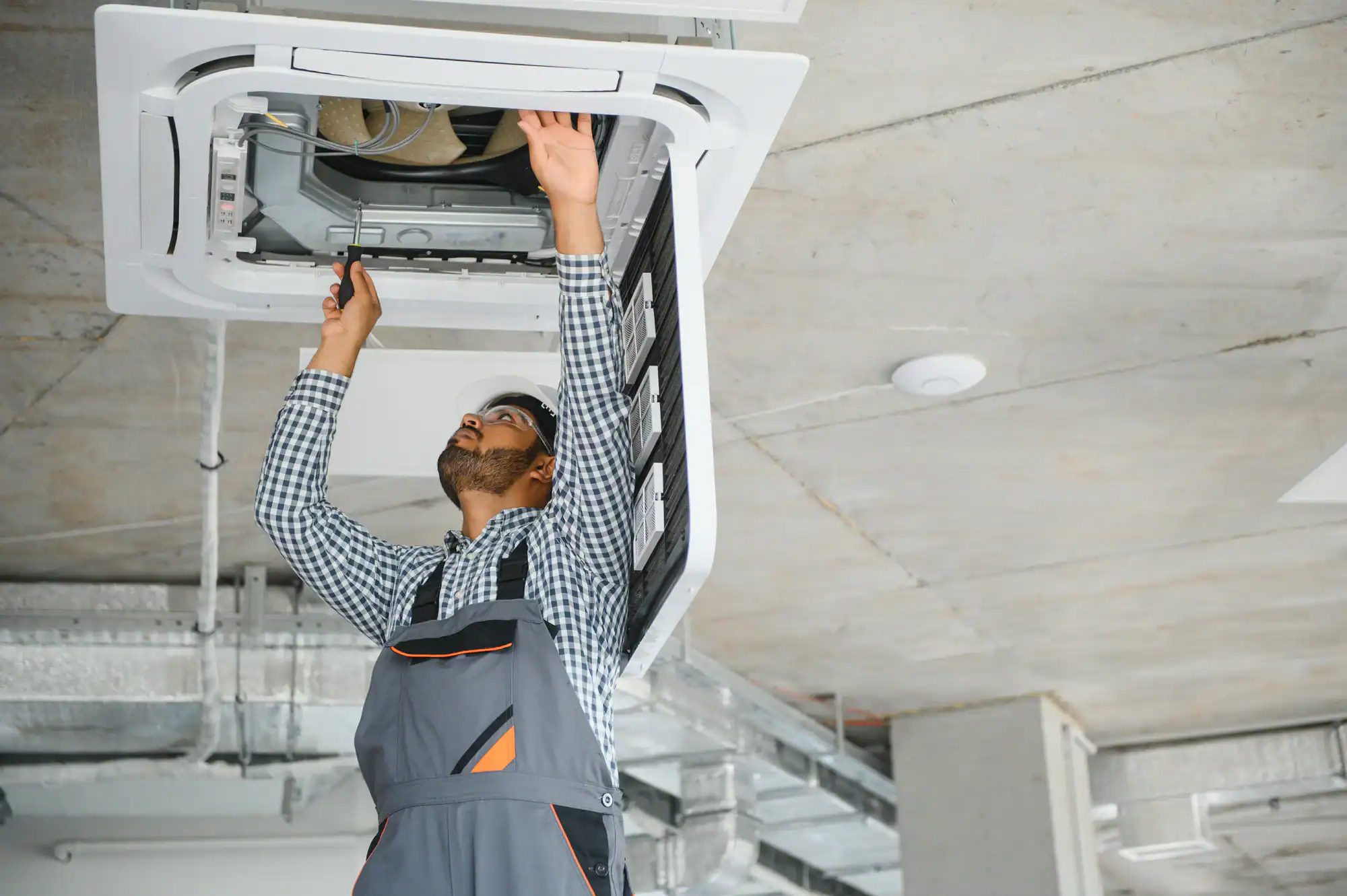
Let’s work through the actual math with real 2026 numbers. A new AC system in Sacramento, CA costs $7,000-$13,000 depending on size, efficiency rating, and installation complexity. We’ll use $10,000 as a realistic midpoint for this example.
Fifty percent of $10,000 is $5,000. Any repair approaching or exceeding $5,000 on a system that’s 10+ years old clearly fails the 50% rule. But most homeowners face murkier decisions in the $1,500-$3,000 repair range where the right answer isn’t immediately obvious.
Your compressor fails. The quote comes back at $2,200. Your system is 12 years old. That’s 22% of replacement cost—well under the 50% threshold. Based purely on that calculation, repair seems reasonable. But your system is past its midpoint lifespan, and that’s where you need to think beyond the immediate repair cost.
Start asking the harder questions. What else might fail in the next 2-3 years? Has this system needed multiple repairs recently? Are your energy bills climbing despite similar usage patterns? Does the system struggle to maintain comfortable temperatures during Sacramento’s peak heat days? If you’re answering yes to several of these questions, that $2,200 compressor repair might be the first of several expensive fixes rather than a solution that buys you five more years.
Consider the warranty situation carefully. A new system comes with manufacturer warranties covering major components for 5-12 years. Your current 12-year-old system? Any repair you make is entirely out-of-pocket. When something else breaks next summer, you’re paying again with zero protection.
Factor in energy costs because they’re real money leaving your account every month. If your current system is rated at 10 SEER or lower, you’re spending 30-50% more on cooling than you would with a modern 16 SEER2 system. For a typical Sacramento County home, that’s $400-$900 per year in wasted energy. Over five years, you’re looking at $2,000-$4,500 in additional costs you could eliminate with replacement.
Now add it all up. The $2,200 repair, plus significantly higher ongoing energy bills, plus the real risk of additional repairs within 1-2 years, plus zero warranty protection on an aging system. When you look at total cost of ownership over the next 5-10 years, spending $10,000 on a new system that will last 15-20 years with warranty coverage and 30-50% lower operating costs often becomes the conservative financial choice.
The 50% rule isn’t just about comparing one repair cost to replacement cost. It’s about understanding total cost of ownership, risk, and value over the realistic remaining lifespan of your current equipment versus the full lifespan of new equipment.
AC replacement costs in Sacramento, CA range from $7,000 to $13,000 for most residential installations in 2026. That’s a significant investment, and understanding what drives those costs helps you evaluate quotes intelligently and avoid overpaying.
System size directly impacts cost. A 2-ton unit for a smaller home costs substantially less than a 5-ton unit for a large house. Your home’s square footage, insulation quality, window placement, ceiling height, and Sacramento’s specific climate all factor into proper sizing. Reputable contractors perform Manual J load calculations—if someone sizes your system based only on square footage or “what was there before,” that’s a red flag.
Efficiency ratings affect both upfront cost and long-term operating expenses. A basic 14-16 SEER2 system costs less initially but runs more expensively every month. A high-efficiency 18-20+ SEER2 system costs more upfront but can slash cooling costs by 30-50% compared to older 10 SEER systems. In Sacramento’s climate where AC runs heavily from May through October and temperatures regularly exceed 100°F, higher efficiency typically pays back within 3-7 years through reduced energy bills.
Installation complexity significantly impacts labor costs and total project expense. If your ductwork needs modification or sealing, your electrical panel requires upgrading to handle new equipment, or your home has challenging access, expect higher installation fees. Straightforward replacements where existing infrastructure is sound and code-compliant cost less than complex installations requiring extensive additional work.
Brand selection matters but probably less than most homeowners think. Carrier, Trane, Lennox, Rheem, Amana, and Daikin all manufacture quality equipment. Installation quality and proper sizing matter far more than brand differences at similar efficiency levels. A perfectly installed mid-tier system will outperform and outlast a poorly installed premium system every single time.
Permits and inspections add $75-$250 to your total cost in Sacramento County, CA. These aren’t optional or negotiable—local building codes require permits for HVAC installations to ensure safety, proper installation, and code compliance. Skipping permits voids manufacturer warranties, creates liability issues, and can cause problems when you sell your home.
Don’t overlook available incentives because they can dramatically reduce your net cost. Federal tax credits offer up to $2,000 back for qualifying high-efficiency systems in 2026. SMUD (Sacramento Municipal Utility District) provides rebates up to $2,000 for heat pump installations. When you stack these incentives, you can reduce your net replacement cost by $2,000-$4,000, making higher-efficiency equipment much more affordable than it initially appears.
When you compare a $10,000 replacement (minus $2,000-$4,000 in available incentives bringing your net cost to $6,000-$8,000) against ongoing repairs on an aging system with no warranty protection and 30-50% higher monthly energy costs, the replacement ROI calculation often favors new equipment faster than homeowners expect. You’re not just buying a new system—you’re buying reliability, efficiency, warranty protection, and peace of mind during Sacramento’s increasingly intense heat waves.
There’s no universal answer that applies to every situation. A 7-year-old system with a minor capacitor issue? Repair it and move on. A 14-year-old system facing its third expensive repair this year while your energy bills keep climbing? Time to replace.
The 50% rule gives you a solid decision framework. Your system’s age, repair history, current efficiency, energy costs, and Sacramento’s brutal summer climate give you essential context. When you combine those factors honestly, the right choice usually becomes clear even if it’s not the choice you wanted initially.
What matters most is making this decision proactively rather than reactively during a heat wave when you’re desperate, uncomfortable, and paying emergency premiums. If your system is 10+ years old, start planning now even if it’s still running. Get replacement quotes. Understand your options and available incentives. Know what replacement would cost so you’re not caught off guard and forced into rushed decisions when that major repair quote arrives during the next 110-degree week.
If you’re facing this decision right now and want honest guidance based on your specific situation without sales pressure, we can help you think through the real numbers. Sometimes repair makes perfect sense. Sometimes replacement is the smarter financial move. Either way, you deserve to understand the actual math before you decide.
Article details:
Share:
Continue learning: