Should you repair that aging AC or invest in replacement? This guide breaks down the decision factors Sacramento homeowners face when their HVAC system starts failing.
Share:

Summary:
Before you can make any repair-or-replace decision, you need to know where your system stands in its lifecycle. Age isn’t everything, but it’s the starting point.
Air conditioners and heat pumps typically last 10 to 12 years. Furnaces hang on a bit longer, usually 15 to 20 years. But here’s the catch: those numbers assume regular maintenance and average use.
Sacramento County isn’t average. When your AC is grinding through 100-degree days for months at a time, it’s working harder than systems in milder climates. That constant strain adds up. Your 10-year-old system might be closer to end-of-life than the same model in a temperate zone.
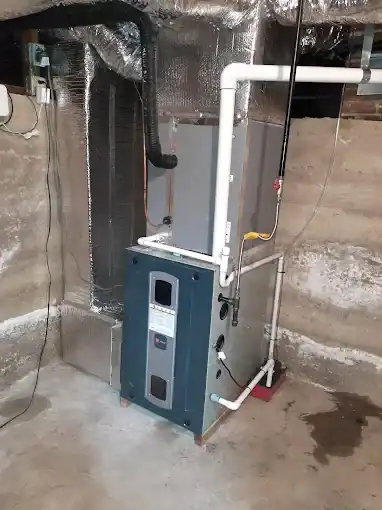
Sacramento County’s climate doesn’t just shorten HVAC lifespan—it attacks your system in specific ways that most homeowners don’t think about until something breaks.
The relentless summer heat forces your air conditioning to run longer cycles. Instead of cooling your home in 15-minute bursts, it’s running 30, 40, or sometimes 60 minutes straight just to keep up. That extended runtime wears out compressors, fan motors, and capacitors faster than they’re designed to handle.
Then there’s the dust. Our dry climate and proximity to agricultural areas mean your system is constantly fighting airborne particles. Those particles clog filters within weeks instead of months. They coat evaporator coils and reduce heat transfer. They work their way into blower assemblies and create friction.
Even if you’re changing filters regularly, the sheer volume of dust and pollen in Sacramento air accelerates wear throughout the system. Your outdoor unit is baking in direct sun while trying to dissipate heat. The temperature differential it’s working against—trying to cool 75-degree indoor air when it’s 108 outside—puts mechanical stress on every component.
This is why a well-maintained 12-year-old system in Sacramento County might be in worse shape than a neglected 15-year-old system in San Francisco. Climate matters. Usage patterns matter. And they matter more than the number on the data plate.
If your system is approaching or past the typical lifespan for its type, and you’re facing a significant repair, that’s your first signal that replacement deserves serious consideration. Not because the system can’t be fixed—it probably can. But because you’re entering the phase where repairs become more frequent and less worthwhile.
Here’s an uncomfortable truth: if you’ve been skipping annual maintenance, your system’s effective age is older than its actual age.
Regular HVAC maintenance isn’t just about keeping things clean. It’s about catching small problems before they cascade into big ones. A worn belt gets replaced during a tune-up. Skip the tune-up, and that belt snaps mid-summer, causing the blower motor to overheat, which then damages the control board. Now you’re looking at a $1,200 repair instead of a $150 belt replacement.
Systems that get annual maintenance can push past their expected lifespan. Systems that don’t rarely make it to the average. If you’re honest with yourself about your maintenance history, that gives you a clearer picture of where your system actually stands.
The flip side matters too. If you’ve been diligent about maintenance and your system is still having problems, that’s telling you something. Well-maintained systems that start breaking down repeatedly are showing you they’re done. The maintenance bought you extra years, but it can’t make components last forever.
This is why repair-or-replace decisions can’t be made by age alone. A neglected 8-year-old system might be a worse investment than a well-maintained 14-year-old one. You have to look at the whole picture: age, maintenance history, current condition, and what’s failing.
When technicians talk about system age, they’re really talking about accumulated wear. In Sacramento County’s climate, with our temperature extremes and constant dust, that wear accumulates faster than in most places. Your 10-year-old system has probably worked as hard as a 15-year-old system somewhere with milder weather.
Want live answers?
Connect with a Hot & Cold HVAC expert for fast, friendly support.
The HVAC industry has a simple guideline that cuts through a lot of the confusion: the $5,000 rule. It’s not perfect, but it’s a solid starting point when you’re trying to decide if a repair makes financial sense.
Here’s how it works: multiply your system’s age by the cost of the repair you’re facing. If that number exceeds $5,000, replacement usually makes more sense than repair. If it’s under $5,000, the repair might still be worthwhile.
Let’s say you’ve got a 12-year-old air conditioning system and you’re looking at an $800 compressor repair. 12 times 800 equals $9,600. That’s well over the $5,000 threshold, which suggests replacement is the smarter move.

The $5,000 rule isn’t arbitrary. It’s based on typical replacement costs and the reality of how systems fail as they age.
When your system is young and something breaks, you’re usually fixing an isolated problem. A capacitor fails. A contactor wears out. These are normal wear items that don’t indicate systemic issues. The repair gets you back to a fundamentally sound system.
When your system is old and something breaks, you’re often fixing the first domino in a chain. Sure, replacing the compressor solves today’s problem. But that 12-year-old system also has an aging blower motor, corroding coils, and electrical components that have been cycling on and off for over a decade. The compressor repair might buy you another year, or it might buy you three months before something else fails.
The $5,000 rule accounts for this reality. It weighs the repair cost against the system’s remaining useful life. A $500 repair on a 5-year-old system ($2,500 total) makes sense because you’re probably getting another 5-7 years out of that system. A $500 repair on a 15-year-old system ($7,500 total) doesn’t, because you’re likely getting 1-2 years at best.
The formula also considers replacement costs. A complete HVAC replacement in Sacramento County typically runs $5,000 to $13,000 depending on system size and efficiency. When your repair calculation exceeds $5,000, you’re approaching the point where the repair cost plus likely future repairs will exceed what you’d spend on a new system anyway.
This is especially true with major component failures. Compressors, heat exchangers, and evaporator coils are expensive repairs. When those fail on an older system, the math almost always points toward replacement. You’re spending repair money that approaches replacement cost, but you’re still left with an old system that has other aging components ready to fail.
The $5,000 rule is a guideline, not a mandate. There are situations where the math says one thing, but the right decision is something else.
If your system is 8 years old and needs a $700 repair, the formula gives you $5,600—just over the threshold. But if that system has been well-maintained and the repair is replacing a failed component rather than addressing a systemic issue, the repair might still make sense. You could reasonably expect another 4-5 years from that system.
On the flip side, sometimes the math says repair, but replacement is still smarter. If you’ve had three repairs in the past two years, even if each individual repair passes the $5,000 rule test, the pattern tells you the system is failing. Those smaller repairs add up, and you’re spending money without gaining reliability.
Energy efficiency throws another variable into the equation. Older systems, especially those 10+ years old, are significantly less effective than modern equipment. Your current system might have a SEER rating of 10 or 11. New systems start at 14 and go up from there. That efficiency difference translates to real money on your energy bills, especially in Sacramento County, where your air conditioning runs hard for months.
If your current system is driving high energy bills, the monthly savings from a new, efficient system can offset the replacement cost over time. This is harder to quantify than a repair quote, but it’s real money leaving your account every month. Sometimes replacement makes financial sense even when the immediate repair cost seems manageable.
Refrigerant type matters too. If your system uses R-22 refrigerant, which has been phased out, any repair involving refrigerant becomes expensive and will only get more expensive. Parts are harder to find. Refrigerant costs have skyrocketed. Even if the $5,000 rule suggests repair, you’re dealing with obsolete technology that will cost more to maintain going forward.
The rule works best as a starting point for the conversation, not the final word. It helps you see if you’re in repair territory or replacement territory, but then you need to look at the specifics of your situation: maintenance history, repair frequency, energy costs, and how much longer you realistically expect the system to last.
Repair-or-replace decisions come down to three core questions: How old is your system? How much will the repair cost? And how many times have you been through this before?
If your system is past its expected lifespan and the repair cost multiplied by age exceeds $5,000, replacement usually makes more sense. If you’re facing frequent repairs even on a newer system, that’s a red flag that something bigger is wrong. And if your energy bills keep climbing despite regular maintenance, you’re paying for inefficiency every month.
The goal isn’t to squeeze every possible year out of a dying system. It’s to make the decision that gives you reliable comfort and makes financial sense over the next 5-10 years. Sometimes that means repairing. Sometimes it means replacing. But it always means looking at the full picture, not just the immediate problem.
When you need honest guidance on what makes sense for your Sacramento County home—regardless of if it’s an emergency repair during a heat wave or evaluating replacement options—we can walk you through where your system stands and what your options are.
Article details:
Share:
Continue learning: